
TITRE : Étude du toucher interpersonnel en situations de conflit
Mots-clés
Interaction Humain-Machine, Interaction Humain-Robot, Réalité Virtuelle, Interaction Haptique, Toucher Interpersonnel, Formation Professionnelle Immersive.
Contexte et Motivation
Le projet ANR MASTERS (Maîtrise de l’Autre et de Soi sous Tension Émotionnelle, Restrictions de ressources et Stress) a pour objectif de créer des simulateurs de formation en réalité virtuelle destinés aux premiers intervenants, en particulier aux forces de l’ordre. L’objectif est d’offrir des entraînements réalistes, sûrs et répétables pour se préparer à des situations tendues : stress, conflits, gestes brusques, non‑coopération. Pour atteindre ce réalisme, MASTERS mise sur une expérience multisensorielle, en se basant notamment sur les retours haptiques : sentir une pression, un contact ou une intrusion de l’espace personnel change la manière dont on perçoit, réagit et apprend. Intégrer des interactions tactiles crédibles dans les simulateurs est donc un levier central pour travailler la désescalade, la gestion du stress et la prise de décision sous tension. Le stage s’inscrit dans cet axe : concevoir et évaluer des retours haptiques qui rendent ces contacts tangibles en VR, afin d’améliorer l’efficacité et l’utilité des simulateurs de MASTERS pour les forces de l’ordre.
Missions
- Réalisation d’une étude de l’état de l’art du
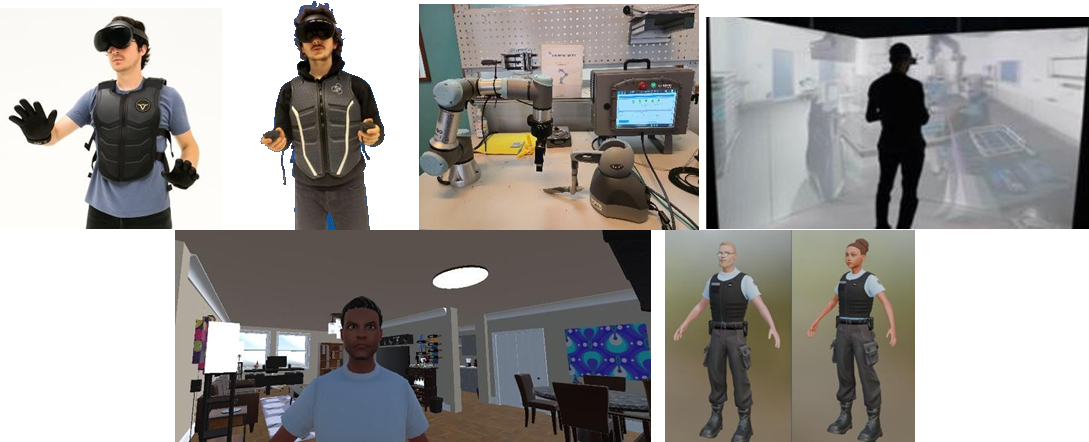
- Participation au développement d’un environnement virtuel en collaboration avec l’équipe du projet : animation d’agents virtuels, intégration de dispositifs haptiques (ex. veste TactSuit).
- Réalisation d’une étude expérimentale : plan expérimental, passations, analyse statistique des données.
- Diffusion scientifique : participation à la rédaction et soumission d’un article scientifique pour diffuser les résultats.
Conditions du stage :
Le stage se déroulera au laboratoire IBISC au sein de l’équipe IRA2, Université Evry Paris Saclay. La/le stagiaire pourra bénéficier des ressources de la plateforme Evr@ (casques VR, vestes et combinaisons haptiques, bras robotiques, environnements virtuels pour la simulation). La personne recrutée sera en interaction avec les doctorants, ingénieurs, post-doctorants et stagiaires de l’équipe.
- Durée du stage : 6 mois (entre février et octobre 2025, selon disponibilités)
- Gratification minimale légale : 35€/h (~ 650€ net par mois)
Profil recherché
- Étudiant·e de Master 2 (ou équivalent) en informatique avec spécialisation en réalité virtuelle/IHM ou domaines proches.
- Très bonne maîtrise du moteur de jeu Unity et de la programmation orientée objet (C#/C++)
- Bonne connaissance des interactions 3D, des dispositifs haptiques et de la méthodologie de conception centrée utilisateur. Des notions en robotique/ROS sont un plus.
- Bonne maîtrise de l’anglais (écrit/oral).
- Qualités recherchées : motivation, autonomie, goût pour la recherche, le travail d’équipe et les échanges
Contacts et modalités de candidature
Amine Chellali (), Manel Boukli Hacene ().
La candidature devra être accompagnée d’un CV détaillé, d’une lettre de motivation, d’une lettre de recommandation, des relevés de notes des deux dernières années, et d’un portfolio/Github (si possible).
References
[1] M. B. Hacene, “[DC] Bridging the Gap Between Real and Virtual Touch : Multisensory Avatars for Enhanced Training in Virtual Reality”n IEEE Conference on Virtual Reality and 3D User Interfaces Abstracts and Workshops (VRW), 2025, pp. 1558-1559, doi: 10.1109/VRW66409.2025.00424 HAL
[2] T. Bosse, T. Hartmann, R. A. M. Blankendaal, N. Dokter, M. Otte, and L. Goedschalk, “Virtually Bad: A Study on Virtual Agents that Physically Threaten Human Beings,” in Proceedings of the 17th International Conference on Autonomous Agents and MultiAgent Systems, in AAMAS ’18. Richland, SC: International Foundation for Autonomous Agents and Multiagent Systems, juillet 2018, pp. 1258–1266.
[3] F. Boucaud, Q. Tafiani, C. Pelachaud, and I. Thouvenin, “Social Touch in Human-agent Interactions in an Immersive Virtual Environment:,” in Proceedings of the 14th International Joint Conference on Computer Vision, Imaging and Computer Graphics Theory and Applications, Prague, Czech Republic: SCITEPRESS – Science and Technology Publications, 2019, pp. 129–136. doi: 10.5220/0007397001290136.
[4] I. Ahmed, V. J. Harjunen, G. Jacucci, N. Ravaja, T. Ruotsalo, and M. M. Spapé, “Touching Virtual Humans: Haptic Responses Reveal the Emotional Impact of Affective Agents,” IEEE Transactions on Affective Computing, vol. 14, no. 1, pp. 331–342, Jan. 2023, doi: 10.1109/TAFFC.2020.3038137
TITLE : Study of interpersonal touch in conflict situations
Keywords
Human–Computer Interaction, Human–Robot Interaction, Virtual Reality, Haptic Interaction, Interpersonal Touch, Immersive Professional Training.
Context & Motivation
The ANR MASTERS project (Mastery of Self and Others under Emotional Tension, Resource Restrictions, and Stress) aims to create virtual-reality training simulators for first responders, particularly law enforcement. The goal is to provide realistic, safe, and repeatable training to prepare for tense situations: stress, conflict, abrupt gestures, and non-cooperation. To achieve realism, MASTERS leverages multisensory cues, especially haptics: feeling pressure, contact, or intrusion into one’s personal space changes how we perceive, react, and learn. Integrating credible tactile interactions into simulators is therefore central to practicing de-escalation, stress management, and decision-making under pressure. This internship focuses on designing and evaluating haptic feedback that makes such contacts tangible in VR, to improve the effectiveness and usefulness of MASTERS simulators for law enforcement.
Missions
- Conduct a targeted literature
- Contribute to the development of the virtual environment with the project team: animating virtual agents, ROS–Unity integration, and integration of the TactSuit haptic vest.
- Design and run an experimental study: experimental plan, participant sessions/data collection, and statistical data analysis.
- Scientific dissemination: writing and submitting results to conferences/journals.
Internship Conditions
The internship will take place at the IBISC laboratory within the IRA2 team, University Évry Paris-Saclay. The intern will have access to the Evr@ platform (VR headsets, haptic suits and vests, robotic arms, virtual simulation environments). The selected candidate will collaborate with the team’s PhD candidates, engineers, postdocs, and interns.
- Duration: 6 months (between February and October 2025, depending on availability)
- Statutory internship stipend: €4.35/hour (~ 650€ net per month)
Profile
- Master’s student (M2 or equivalent) in computer science, virtual reality, or a related
- Strong command of the Unity engine and object-oriented programming in C#/C++.
- Good knowledge of 3D interaction, haptic devices, and user-centered design, Familiarity with robotics/ROS is a plus.
- Good command of English (written and spoken).
- Desired qualities: motivation, autonomy, enthusiasm for research, teamwork, and interdisciplinary
Contacts & Application
Amine Chellali () , Manel Boukli Hacene ().
Applications should include: a detailed CV, a cover letter, one letter of recommendation, transcripts for the last two years, and a portfolio/GitHub (if available).
References
[1] M. B. Hacene, “[DC] Bridging the Gap Between Real and Virtual Touch : Multisensory Avatars for Enhanced Training in Virtual Reality”n IEEE Conference on Virtual Reality and 3D User Interfaces Abstracts and Workshops (VRW) pp. 1558-1559, doi: 10.1109/VRW66409.2025.00424 HAL
[2] T. Bosse, T. Hartmann, R. A. M. Blankendaal, N. Dokter, M. Otte, and L. Goedschalk, “Virtually Bad: A Study on Virtual Agents that Physically Threaten Human Beings,” in Proceedings of the 17th International Conference on Autonomous Agents and MultiAgent Systems, in AAMAS ’18. Richland, SC: International Foundation for Autonomous Agents and Multiagent Systems, juillet 2018, pp. 1258–1266.
[3] F. Boucaud, Q. Tafiani, C. Pelachaud, and I. Thouvenin, “Social Touch in Human-agent Interactions in an Immersive Virtual Environment:,” in Proceedings of the 14th International Joint Conference on Computer Vision, Imaging and Computer Graphics Theory and Applications, Prague, Czech Republic: SCITEPRESS – Science and Technology Publications, 2019, pp. 129–136. doi: 10.5220/0007397001290136.
[4] I. Ahmed, V. J. Harjunen, G. Jacucci, N. Ravaja, T. Ruotsalo, and M. M. Spapé, “Touching Virtual Humans: Haptic Responses Reveal the Emotional Impact of Affective Agents,” IEEE Transactions on Affective Computing, vol. 14, no. 1, pp. 331–342, Jan. 2023, doi: 10.1109/TAFFC.2020.3038137
- Date de l’appel : 03/12/2025
- Statut de l’appel : Pourvu
- Contacts : Amine CHELLALI (MCF Univ. Évry, IBISC équipe IRA2), Manel BOUKLI HACENE (doctorante IBISC équipe IRA2/LMEE/LS2N) amineDOTchellaliATuniv-evryDOTfr, manelDOTbouklihaceneATuniv-evryDOTfr
- Sujet de stage niveau Master 2 (format PDF)
- Web équipe IRA2
- Plateforme EVR@