
IBISC Laboratory · Université Évry Paris-Saclay · 19 April 2026
Beijing Humanoid Half-Marathon 2026
The only French team invited to an unprecedented worldwide scientific event — a full-scale test of humanoid robotics over 21.1 km in real outdoor conditions.
🇫🇷 Only French team
🤖 Unitree G1 platform
📺 CCTV-13 coverage
🇨🇳 Sino-French cooperation
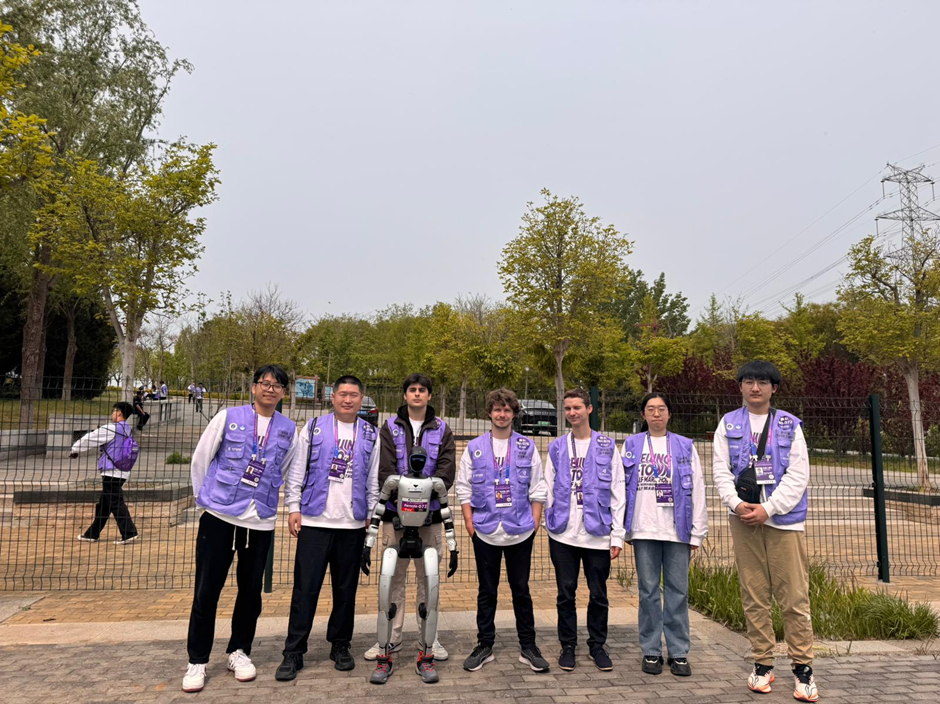
The IBISC × Université Évry Paris-Saclay delegation at the start — Beijing E-Town, April 2026.
Key facts
- Date19 April 2026
- VenueBeijing E-Town, China
- Distance21.0975 km · outdoor
- Delegation7 members: 1 faculty, 2 PhD students, 4 Master MMVAI students
- PlatformUnitree G1
- EntitiesSaclay Sprint Syndicate · Saclay-SCUT Robotics Alliance
- PartnerSouth China University of Technology
Seven key takeaways from the project
1
An unprecedented global event
The first full-scale test bench evaluating the maturity of humanoid robots in outdoor conditions: locomotion, stability, control, perception, and long-duration robustness.
2
IBISC, the only French team invited
A participation organized under two banners — Saclay Sprint Syndicate (the French team) and Saclay-SCUT Robotics Alliance (Sino-French collaboration with South China University of Technology).
3
Two weeks of intensive on-site preparation
Rapid cycles of testing, diagnosis, adjustments, and optimizations on the Beijing site. Hardware verification, communications validation, and gait calibration in real conditions.
4
A distinctive scientific signature
Three original technical contributions: smart insoles (foot–ground interaction and stability analysis), wearable textile sensors (contact detection, safety), motion capture for upper/lower body coordination.
5
Nationwide media visibility in China
A CCTV-13 interview broadcast and relayed by dozens of Chinese media outlets. A boost to the visibility of Université Évry Paris-Saclay and the IBISC laboratory within the Chinese robotics ecosystem.
6
A strong educational impact
Involvement of 2 PhD students and 4 Master MMVAI students. Remarkable engagement, rigor, and motivation. A model for project-based learning, international mobility, and engineering in a demanding real-world environment.
7
Success on five levels
Scientific (real-world validation) · Technical (multimodal integration) · Institutional (international visibility) · Media (CCTV-13 + relays) · Educational (training through fieldwork).
Media coverage & international cooperation

CCTV-13
Interview broadcast on Chinese national television.

Unitree G1 platform on site at Beijing E-Town.
The event drew nationwide Chinese coverage via CCTV-13 and was relayed by numerous specialized outlets. Beyond the competition itself, the Sino-French integration embodied by the Saclay-SCUT Robotics Alliance illustrated IBISC's ability to operate at the intersection of research, engineering, education, and cross-cultural collaboration.
“ The main challenge today is less about intelligence alone than about robustness and reliability in a real-world environment. ”
— Hang Su, head of delegation
- Participants:
- Hang SU (CPJ IBISC, University of Evry)
- 1 intern from the M2-MMVAI program, completing an internship at South China University of Technology, Guangzhou, China: Rayan PINTURAUD
- 3 IBISC interns from the M2-MMVAI program, supervised by Hang SU (CPJ IBISC, Univ. Evry): Xiaotong HE, Hanbing LIU, Feilong WANG
- 2 PhD students from the IRA2 team supervised by Samer ALFAYAD (Professor, Univ. Evry, IBISC IRA2 team) and Hang SU (CPJ IBISC, Univ. Evry): Yunus SCHMIRANDER, Etienne LARGETEAU
- Post on the Univ. Evry Paris-Saclay website (French)
- Chinese Cover 1 and Chinese Cover 2